
Your Cart is Empty


- Champagne
- Gifts & Hampers
- Whisky & Spirits
- Wine
- Caviar & Gourmet
- Same-Day Delivery
- Beer
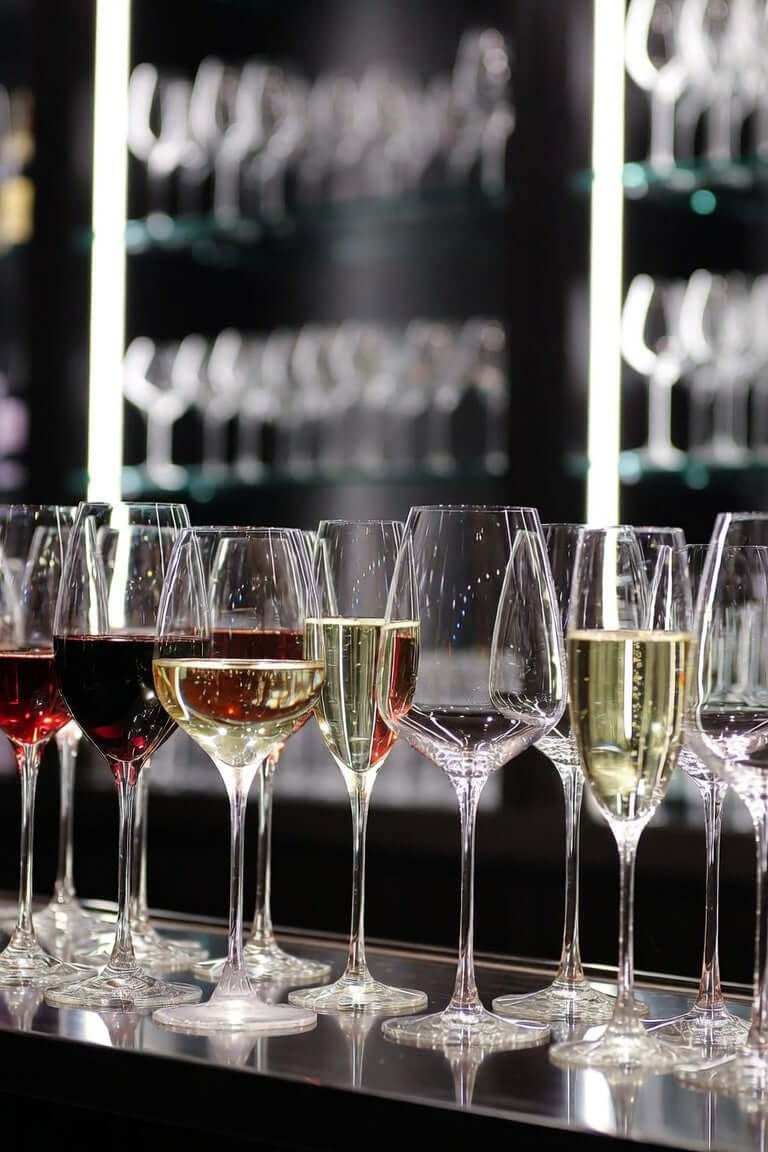
There are companies that will sell you a different glass for every grape variety. Riesling, Sauvignon Blanc, Nebbiolo, Chardonnay from oak, Chardonnay without oak. It looks absurd, and much of it is. But the underlying claim, that the shape of a glass changes how a wine tastes, is genuinely true, and understanding why lets you buy three sensible glasses rather than eighteen silly ones.
Wine glass shapes work on aroma. Around eighty percent of what you experience as flavour arrives through the olfactory receptors at the top of your nasal cavity, not the tongue. Your tongue detects sweet, sour, salt, bitter and umami, plus texture and temperature. Everything else, every mention of blackcurrant, gooseberry, leather or wet stone, is smell. A glass is essentially a device for delivering a specific concentration of volatile aromatic compounds to your nose.
Bowl width determines how much wine surface is in contact with air. More surface area means faster evaporation of alcohol and aromatics, and faster softening of tannin and any reductive notes. That is why a big Burgundy bowl suits a delicate, aromatic red like Pinot Noir which needs coaxing, while a narrower bowl suits an aromatic white which would otherwise blow off within minutes.
Rim diameter determines how concentrated the aroma is when it reaches you, and where the wine lands in your mouth. A tapered rim funnels aromatics into a tighter column. A wide flared rim disperses them.
Glass thickness has no chemical effect at all but a substantial perceptual one. A fine rim, under a millimetre, disappears against the lip and the wine seems to arrive without an intermediary. A thick, rolled rim announces itself. Blind tests repeatedly show people rate the same wine higher from a thinner glass. That is not a chemical effect, but it is a real experience, and it is the single upgrade most worth paying for.
Start with a universal glass, sometimes sold as a Chardonnay glass or an all-purpose glass. Roughly 500 to 550ml total capacity, a slightly tapered rim, a stem you can hold. This handles Sauvignon Blanc, Chardonnay, Riesling, rosé, Rioja, Malbec, Chianti and most Bordeaux perfectly well. Buy six.
Add a large-bowled glass of 650ml or more for Burgundy, Pinot Noir, Nebbiolo and older reds. These wines are all about perfume and benefit from air. If you drink a lot of light, aromatic reds this is your most-used glass; if you mostly drink Cabernet and Shiraz you can skip it.
Add something for sparkling wine. A tulip glass, narrower than a white wine glass but wider than a flute, is the best compromise, giving you aroma without losing the bubbles in two minutes.
That is it. Anything beyond three shapes is a hobby rather than a necessity. If you are choosing between spending on a fourth shape or on a better bottle from the wine range, buy the wine.
Almost nobody pours correctly. A wine glass should be filled to the widest point of the bowl and no higher, which in a 550ml glass is roughly 150ml, or about a fifth of the glass. This leaves the maximum surface area for evaporation and a large headspace where aromatics collect. If you fill a big glass to the top you have removed the entire reason for owning it and you have created a wine that warms up before you finish it.
Swirling is not affectation. It coats the inside of the bowl with a thin film that evaporates rapidly and refreshes the aromatic headspace. Do it on the table rather than in the air until you are confident, and stop after two or three rotations.
Hold the stem or the base, not the bowl. Body heat transfers through glass quickly, and a white wine served at a well-judged 9 degrees will be at 14 within ten minutes if you cup the bowl.
On serving temperature: most British homes serve white too cold and red too warm. Room temperature as a standard was set when rooms were 16 degrees, not 22. Light reds like Beaujolais or a young Pinot Noir are genuinely better with twenty minutes in the fridge. Full-bodied reds from the red wine selection are at their best around 16 to 18 degrees. Whites want 8 to 12, sparkling 6 to 8.
Wash glasses in hot water with minimal detergent and dry with a lint-free cloth while still warm. Detergent residue kills the mousse on sparkling wine faster than anything else, which is why a glass straight from the dishwasher often produces a flat-looking pour. Store glasses upright rather than on their rims, since resting on the rim both risks chipping and traps stale cupboard air inside the bowl.
Stemless glasses are practical for a garden party or a crowd, easier to store and harder to knock over. They also guarantee a warm wine and fingerprints across the bowl. Use them for casual outdoor drinking and keep stems for anything you actually care about.
Lead-free crystal is thinner, stronger and more transparent than standard glass, which is why the good ones cost what they do. Whether that is worth it depends entirely on how often you drink wine and how heavy-handed your household is with the washing up. A mid-priced machine-blown crystal glass gets you most of the benefit at a fraction of the price of hand-blown.
The honest summary is that wine glass shapes matter, but far less than temperature, far less than freshness, and far less than the wine itself. Get three shapes, keep them thin and clean, pour to the widest point, and stop worrying.
If you would rather spend the evening drinking than shopping, we deliver wine, champagne and everything else across London inside the M25 in 30 to 45 minutes, 24 hours a day. Check the areas we cover and pour something worth the glass.
Please drink responsibly. Drinks House 247 operates a Challenge 25 policy - you must be 18 or over to order, and our drivers will ask for photo ID if you look under 25.
Comments will be approved before showing up.