
سلة التسوق الخاصة بك فارغة


- الشمبانيا
- مجموعات الهدايا
- الارواح
- خمر
- الزهور والشوكولاتة
- المشروبات الغازية
- البيرة وعصير التفاح
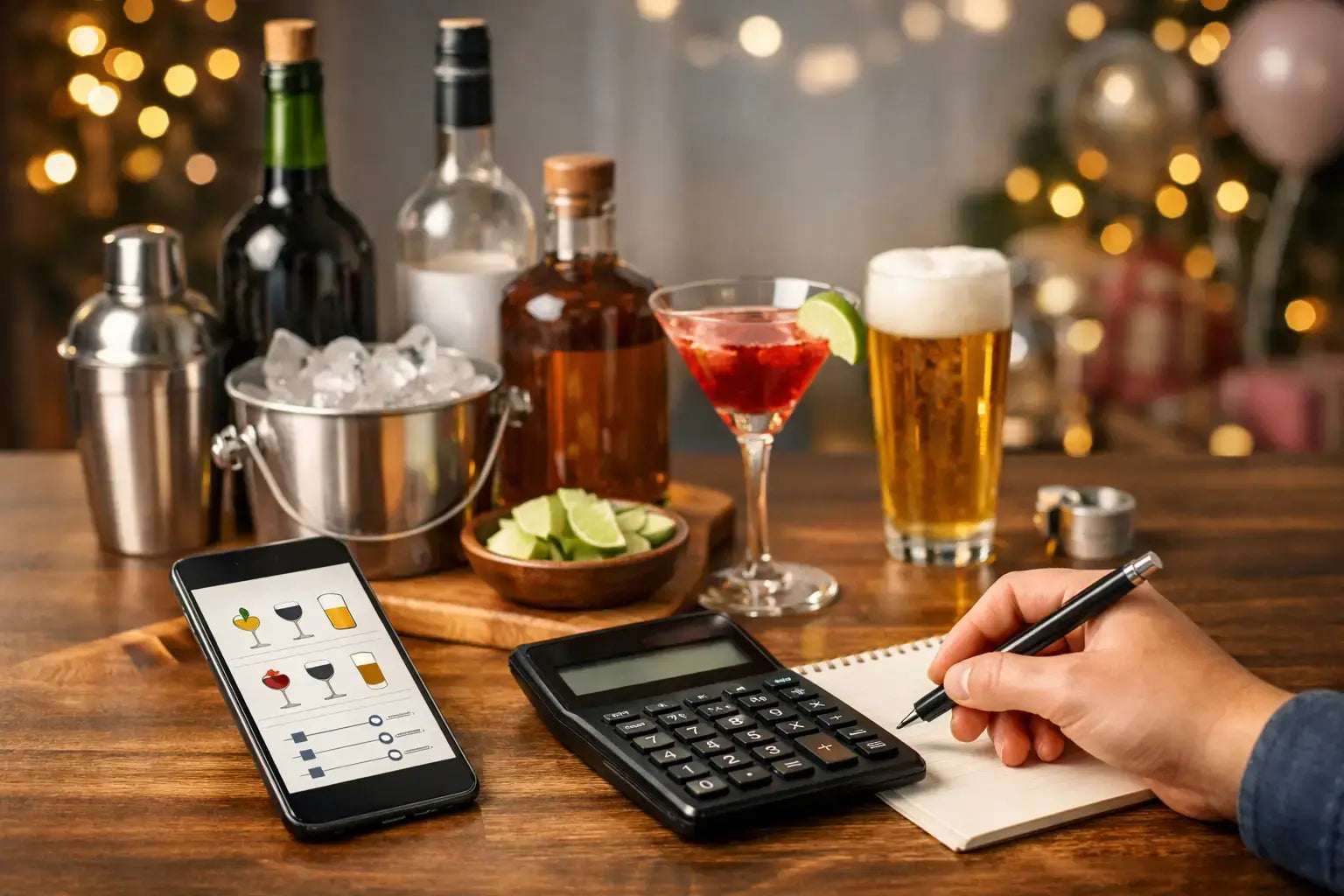
Running out of drinks is the fastest way to make a host look underprepared. Overbuying is hardly better when you are left with half-open mixers, warm beer and a bill that felt reasonable until the next morning. A good party alcohol calculator takes the guesswork out of both problems. It gives you a practical starting point based on guest numbers, event length and what people are actually likely to drink.
This is not about getting every bottle exact to the last glass. Parties do not work like that. It is about buying with enough confidence to cover the room, keep service smooth and avoid spending heavily on stock that never gets opened.
At its simplest, a party alcohol calculator estimates total servings, then splits them across categories such as wine, beer, spirits, soft drinks and water. The useful part is not the maths itself. The useful part is matching the order to the type of event you are hosting.
A two-hour birthday drinks gathering calls for a different mix from a six-hour dinner party. An office celebration usually leans more heavily on beer, wine and low-alcohol options. A formal engagement party may shift towards Champagne on arrival, wine with food and fewer spirits overall. The calculator gives you a baseline, but the event style should always shape the final order.
As a rule, most adult guests will drink between two and four alcoholic servings over a standard social event. That number rises if the party runs late, if there is no sit-down meal, or if the guest list skews younger. It drops if the event is daytime, food-led or family-oriented.
The biggest mistake hosts make is treating every guest the same. They are not. If you have invited 20 people, that does not mean 20 drinkers. Some will not drink alcohol at all. Some will have one glass and switch to water or soft drinks. Others will happily move from prosecco to cocktails to whisky if the options are there.
That is why any party alcohol calculator should begin with three questions. How many adults are attending? How long will the event last? Will food be served, and if so, how substantial is it?
For a short evening gathering of 20 adults with nibbles, you might plan around 50 to 60 alcoholic servings in total. For a dinner party of the same size, you could come in lower because food slows consumption and focuses people on wine pairings rather than constant top-ups. For a house party with music and no real meal, you would usually buy more.
It also helps to think about your guest mix in percentages rather than names. If around half the room drinks wine, a quarter prefers beer and the rest want spirits or mixed drinks, that is a far better buying guide than a generic average.
If you need a working model, wine usually carries more of the load than people expect. It suits mixed groups, works well with food and keeps service simple. Beer is easy to stock and easy to serve, but it can disappear quickly in warm weather or at casual gatherings. Spirits add flexibility and premium appeal, though they also create the most complexity because you need mixers, garnish and enough glassware.
For a balanced event, a sensible split is often around 40 to 50 per cent wine, 25 to 35 per cent beer, and 20 to 30 per cent spirits and cocktails. That is not a fixed rule. It depends on the crowd. If you are hosting city professionals for after-work drinks, sparkling wine and premium lager may move faster than red wine. If it is a winter birthday at home, red wine and dark spirits may do more work than chilled beer.
Champagne and sparkling wine deserve separate planning if the event has an arrival moment, toast or celebration focus. Guests often take a glass simply because it is offered at the start, even if they switch to something else later. That means one bottle per six to eight guests for a single welcome glass is usually enough, while one bottle per three to four guests is safer if sparkling wine will stay in circulation throughout the evening.
This is where many hosts miscalculate. They estimate total alcohol correctly, then buy the wrong format. Bottles matter. So do serves.
A 750ml bottle of wine gives around five medium glasses. A 750ml bottle of spirits gives roughly 16 to 17 single measures. A case of beer sounds generous until you realise how quickly bottles disappear when guests help themselves. If you are planning simple gin and tonic or vodka mixers, spirits can be cost-effective. If you are planning espresso martinis for everyone, the stock requirements climb fast.
The easiest way to stay in control is to keep the menu tight. Instead of trying to cover every possible taste, offer one sparkling option, one or two wines, one beer choice and one or two simple spirit serves. That feels considered rather than limited, and it makes your numbers much easier to manage.
Alcohol planning falls apart quickly when the non-alcoholic side is treated as an afterthought. Guests expect choice. Drivers, lighter drinkers and anyone pacing themselves will notice immediately if the table only offers warm orange juice and tap water in a jug.
Plan proper soft drinks with the same care as the alcohol. Tonic, soda, cola, lemonade and juice should match the spirits you are serving. Still and sparkling water should be easy to reach all evening. Ice should be bought in more generous quantities than you think you need, especially if beer, white wine and mixers are being chilled on demand rather than stored in a fridge.
This is also where a premium event can slip into a rushed one. Smart hosting is not about loading the room with alcohol. It is about making the drinks service feel complete.
There are moments when buying more is the right call. Hot weather is one. So is a Friday or Saturday evening crowd that starts early and stays late. Celebrations with no fixed end time also tend to drift upwards in consumption. If guests are travelling in by Tube or taxi rather than driving, that changes the picture too.
On the other hand, not every event needs a heavy stock-up. Daytime baby celebrations, family lunches, work events and food-led dinners usually require more restraint. If you are serving a proper meal, guests often value quality over quantity. Fewer bottles of better wine can make more sense than a broad but average drinks table.
There is also the budget question. A party alcohol calculator helps you avoid panic buying, but it can also help you trade up intelligently. Instead of over-ordering on volume, you might choose a stronger core range - a respected Champagne house for the toast, a reliable Provence rosé, a crisp Sauvignon Blanc, a smooth Rioja, and a clean premium spirit for mixed drinks.
If the party has come together quickly, the priority is not perfection. It is coverage. In that situation, keep the order straightforward and versatile.
A practical last-minute mix for a mixed adult crowd is sparkling wine for arrival, two still wines, one beer line, one spirit with matching mixers, plus plenty of water and soft drinks. That covers most preferences without overcomplicating the basket. For London hosts working to a tight timetable, a fast service such as Drinks House 247 can make that kind of rescue order far less stressful when the guest list suddenly grows or the drinks table looks light.
The key is resisting the urge to buy one of everything. Speed rewards clarity. A short, sensible order usually performs better than a chaotic one.
The first is ignoring drink sequencing. Guests do not drink randomly. They often start with sparkling, move to wine or beer, and then shift to spirits later. If all your budget goes on spirits, the opening hour can feel strangely flat.
The second is buying too much red wine for events where people are standing. Red often works best when there is food, seating and time to enjoy it. At mingling events, chilled white, rosé, sparkling and beer tend to move faster.
The third is assuming everyone drinks at the same pace. A few enthusiastic guests can distort the table early, so it helps to hold some stock back and replenish steadily rather than placing everything out at once.
That is the real value of a party alcohol calculator. It is a planning tool, not a rulebook. It gives you structure, but good hosting still comes down to reading the room, knowing your guests and buying for the occasion rather than the spreadsheet.
If you are planning a relaxed dinner, let the wine do the work. If it is a birthday with movement and music, widen the mix and increase the cold drinks. If it is a premium celebration, buy less filler and more quality. The smartest order is rarely the biggest one. It is the one that feels well judged from the first pour to the final glass.
When in doubt, aim for enough choice, enough chill and enough flexibility to handle the evening as it unfolds. Guests remember that far more than they remember the exact bottle count.
سيتم الموافقة على التعليقات قبل ظهورها.